Three to thirty times more, depending on what exactly is being measured. The French regulator records +92% energy on average across 22 open models, with peaks at +849% on code generation. The Hugging Face leaderboard records 30 times more on average between models, and up to 700 times for the same model with and without reasoning.
These figures measure different things. And close to half the reasoning tokens produced can be removed with no measurable loss of accuracy.
Reasoning means producing more text
A model applies exactly the same number of operations to every token it produces. No internal loop, no recursion: the model does not "think for longer" on a given case. Compute per token is twice the number of active parameters, in FLOP, and nothing else.
You spend the compute during the answer rather than during training. Since the budget per token is fixed, the only way to give a problem more of it is to produce more tokens.
For a carbon assessment the consequence is direct: the chain of thought is extra output volume, billed and consumed as such.
Until 2024, chain of thought was a prompting trick. Since o1 and R1, it is a behaviour learned through reinforcement, with a verifiable reward on code and maths. The model learns to produce long drafts because it scores better that way.
Six measurements, six scopes
| Multiplier | What is compared | Scope |
|---|---|---|
| +92% on average, up to +849% | reasoning mode on against off, in energy | 22 open models from 3 to 123 billion parameters, Jean Zay supercomputer, CEEMS tooling, GPU only (PEReN for Arcep, May 2026) |
| ×3.5 to ×4.5 | tokens generated, QwQ-32B against Llama-3.3-70B | ASDIV, GSM8K and MATH500 (Chen et al., arXiv:2412.21187, December 2024) |
| ×30 on average, ×150 to ×700 for the same model | with and without reasoning, Wh per 1,000 requests | H100, GPU only, no request batching (AI Energy Score v2, December 2025) |
| ×25 | conversation against problem solving, 184 J against 4,625 J per response | B200, vLLM serving engine, GPU only (ML.Energy v3.0, January 2026) |
| ×13 | traditional regime against test-time scaling, 0.31 against 3.91 Wh median | models above 200 billion parameters, full node plus building efficiency, Monte Carlo simulation (Oviedo et al., Joule 2026) |
| ×4 to ×6 | reasoning against text-only modes, in emissions | 14 open models, A100, Perun measurement (Dauner and Socher, Frontiers in Communication, June 2025) |
The ×30 is an average across models, measured without request batching. The ×13 is a median under simulated production conditions, while the +92% covers GPUs alone on mid-sized open models. Stacking these numbers, or averaging them, would produce a figure matching no real scope at all.
The order of magnitude you can defend in front of a client: a reasoning model generates 3 to 5 times more output tokens than a direct model on the same task, and energy follows a factor of the same order, with tails running into the hundreds.
The spread itself is instructive. On the AI Energy Score v2 runs: SmolLM3-3B multiplies by 697, Phi-4-reasoning-plus by 514, DeepSeek-R1-Distill-Llama-70B by 154, and Qwen3-235B-A22B barely moves, from 306 to 301 Wh per thousand requests. An average of 30 hides three orders of magnitude. So a single emission factor for "reasoning models" means nothing.
A good share of those tokens does nothing
Chen et al. document what they call overthinking. On the sum "2+3", QwQ-32B-Preview generates 13 distinct solutions for a total of 901 tokens. Their headline measurement: o1-style models consume 1,953% more tokens than classic models to arrive at the same answer.
Average tokens generated, same task, two models:
| Dataset | Llama-3.3-70B, direct | QwQ-32B, reasoning | Multiplier |
|---|---|---|---|
| ASDIV | 166.4 | 741.8 | ×4.5 |
| GSM8K | 220.3 | 772.8 | ×3.5 |
| MATH500 | 553.4 | 2,407.9 | ×4.3 |
Their reduction method brings MATH500 down from 2,407.9 to 1,330.7 tokens, or −44.8%, for an accuracy of 92.8% against 93.0% originally. You lose two tenths of a point of quality and save nearly half the tokens.
The French regulator says the same thing differently: reasoning mode costs +92% energy "for a performance gain that varies by task".
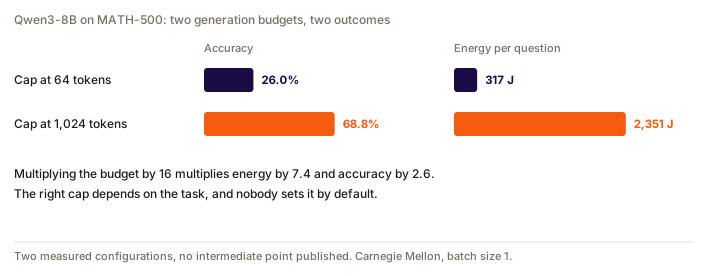
The trade-off is adjustable, and it can be measured. A Carnegie Mellon team capped output length on Qwen3-8B over the MATH-500 set: at 64 tokens, 26% accuracy for 316.8 J; at 1,024 tokens, 68.8% for 2,351.2 J. The generation budget dominates everything else, and you get to choose it.
Question
A team turns reasoning mode on by default across all its routes, including rewriting customer support tickets. Which argument works best for switching it off on that route?
Choisissez une réponse pour voir l'explication.
The setting exists, nobody publishes what it does
All three major providers expose a dial.
| Provider | Parameter | Values |
|---|---|---|
| Anthropic | output_config.effort | low, medium, high by default, xhigh, max |
thinking_level | minimal, low, medium, high, depending on the model | |
| OpenAI | reasoning_effort | values not extracted from the public pricing page |
Anthropic's documentation states the scope of the setting: it affects all tokens in the response, text, tool calls and reasoning alike, and is "a behavioural signal, not a strict token budget".
No provider publishes what an effort level actually does to token counts. The documentation stays qualitative, along the lines of "expect significantly higher consumption". The data is missing, and it can be measured in an afternoon: run the same set of tasks at each level and read the output_tokens field the API returns. That is the number to keep, because it covers the client's real tasks.
What you pay for without always seeing it
Reasoning tokens are billed at the output rate, even when the text is not shown. Anthropic writes it plainly: "the tokens Claude spends reasoning are billed as output tokens, even when the thinking text isn't returned to you". Google too: "Pricing is based on the full thought tokens the model needs to generate, despite only the summary being output from the API".
On recent Anthropic models, the API keeps reasoning blocks from previous turns by default, and they count towards the context window like any input token.
A reasoning token is therefore billed once at the output rate when it is produced, then at the input rate on every subsequent turn of the conversation. On earlier generations, those blocks were dropped from the history.
This mechanism amplifies the way a conversation's cost grows, which is the subject of the next chapter.
One last point, so you do not get the phase wrong: at the ENS/OBVIA conference in July 2026, Emma Strubell put reasoning models at up to 17 times more training energy than classic models, because they add a learning phase dedicated to producing long chains. The reasoning premium is not paid only in use.
That figure comes from a spoken talk, with no paper and no written scope behind it. Treat it as an order of magnitude put forward by a researcher in the field, never as a measurement.
FAQ
Does an LLM's reasoning mode use much more energy?
Yes, by a ratio of 3 to 30 depending on the measurement scope. The PEReN study for Arcep, run on 22 open models at the Jean Zay supercomputer in May 2026, measures +92% energy on average with peaks at +849% on code generation. Hugging Face's AI Energy Score leaderboard, measured without request batching, records a factor of 30 on average across models.
Why does a model that reasons consume more?
Because a model applies the same number of operations to every token it produces, with no internal loop available. The only way to give a problem more compute is therefore to write more tokens. The chain of thought is a draft, and every line of that draft costs as much as a line of the final answer, in energy as in billing.
Are reasoning tokens billed even when they are not displayed?
Yes, at the output token rate across all three major providers. Anthropic states that the tokens spent reasoning are billed as output tokens even when the text is not returned. Google specifies that pricing covers the full set of thought tokens produced, while only a summary leaves the API.
Can you cut the cost of reasoning without losing quality?
Substantially, on many tasks. Chen et al. show a reduction method that brings chain length down from 2,407.9 to 1,330.7 tokens on the MATH500 set, a drop of 44.8%, for an accuracy of 92.8% against 93.0% originally. On tasks where reasoning adds nothing, switching it off removes a cost with no counterpart.
How do I measure what the effort level does to my own consumption?
No provider publishes that figure, and the documentation stays qualitative. The measurement has to happen in house: run the same set of representative tasks at each available effort level, then read the output token count the API returns in its usage field. It takes an afternoon and gives you the number that matters, the one for your real tasks.